I picked up some new colors for my birthday and finally got a palette that would truly organize my watercolors rather than taking them from the tubes each time I used them.
I can't wait to play with them!
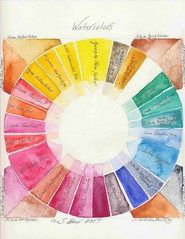
I placed them roughly in a color wheel format, but since I hadn't used a number of these before they're not in the exactly places where I'd put them now that I've really tested them out on paper.
Hodgepodge
My husband kindly gave me my first artist-quality watercolors from his collection. Over the last few years, I've acquired a few as necessary when I did specific calligraphy projects.
Finally, I felt I was doing enough additions of watercolor to my works, especially with transparent stained-glass effects, that I justified taking my birthday money straight to Daniel Smith last week to fill in the gaps. Though it's not the way I'd have acquired them if I were starting out fresh, building a collection a bit at a time eased some of the financial pain.
I tried not to get too many new ones that overlapped with the gouaches I already have. Hence my favorite color, cobalt blue, isn't on here.
NOTE: I'm very lucky to have a Daniel Smith store just a few miles from my home. They're one of the premier art stores in the U.S. and they also make many of their own artist-quality paints.
PrimaTeks
The first new set I picked up are the PrimaTeks, derived from grinding actual stones. Rhodalite (bottom left), Lapis Lazuli (bottom right), Turquoise (upper right) are some of the stunning examples.
I plan on using these both to make my nature illustrations look more natural and to make my illuminated lettering more historical.
Most of them have a lovely granulating quality (i.e., the pigment settles unevenly so it looks more pebbly). The Purpurite and Sodalite in the bottom right show this off especially well.
Quinacridones
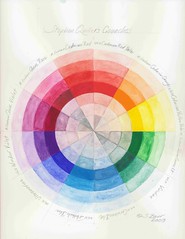
After I put the watercolors into the palette (designed by Stephen Quiller who I mentioned in yesterday's post), I noticed I had very few oranges, reds, pinks, violets, and purples. I decided I'd pick up Daniel Smith's Quinacridone Set.
I felt these colors would liven up a number of my works and wanted some more transparent colors in addition to the mostly granulating qualities of the PrimaTeks.
True Color Wheel
Because it was built in such a hodgepodge fashion, it hasn't been constructed to have exactly complementary matches all around like my gouache palette. (And, I do have more gouaches than just these.)
Since I already have a true color wheel, I felt freer to experiment, choosing new additions that I felt would work in the contemporary updates of historical styles I already do. Especially with the stained glass effects I like so much and that pop in my scanned work.



 Posts
Posts


Work complete on the Parish Hall window wall
2 years ago


